
DISC vs MBTI vs Insights Discovery: Which to Use?
DISC vs MBTI: Which Team Assessment Actually Changes Behaviour?
The debate isn't about which model is more interesting. It's about which one your managers will still be using three months after the workshop. Here's the honest read on the research, the cost, and the stickiness.
You have budget for one team assessment this year. Three vendors are pitching you, and every one of them claims their tool builds "self-awareness." The question none of their decks answer: which one actually changes how your team behaves on Tuesday?
That's the real test. The DISC vs MBTI debate isn't about which model is more interesting. It's about which one your managers will still be using three months after the workshop.
I've run communication styles sessions with hundreds of teams, and I've watched all three tools succeed and fail. The pattern is consistent: the assessment matters less than most buyers think, and the follow-through matters far more. But the tools are not interchangeable, and the research on them is not equal. Our Applied EQ and DISC workshop is built on DISC for reasons I'll lay out below, with the evidence, so you can make this call the way you'd make any vendor decision.
The Three Tools in Plain English
Strip away the branding and this is what each one measures.
MBTI sorts people into 16 types across four letter pairs, based on Jungian theory about how people prefer to take in information and make choices. It describes your inner wiring. It was never designed to predict workplace behaviour.
DISC measures observable behaviour across four styles: Dominance, Influence, Steadiness, and Conscientiousness. It doesn't try to explain your psyche. It describes how you tend to act, communicate, and respond to pressure, which is exactly the stuff your teammates experience.
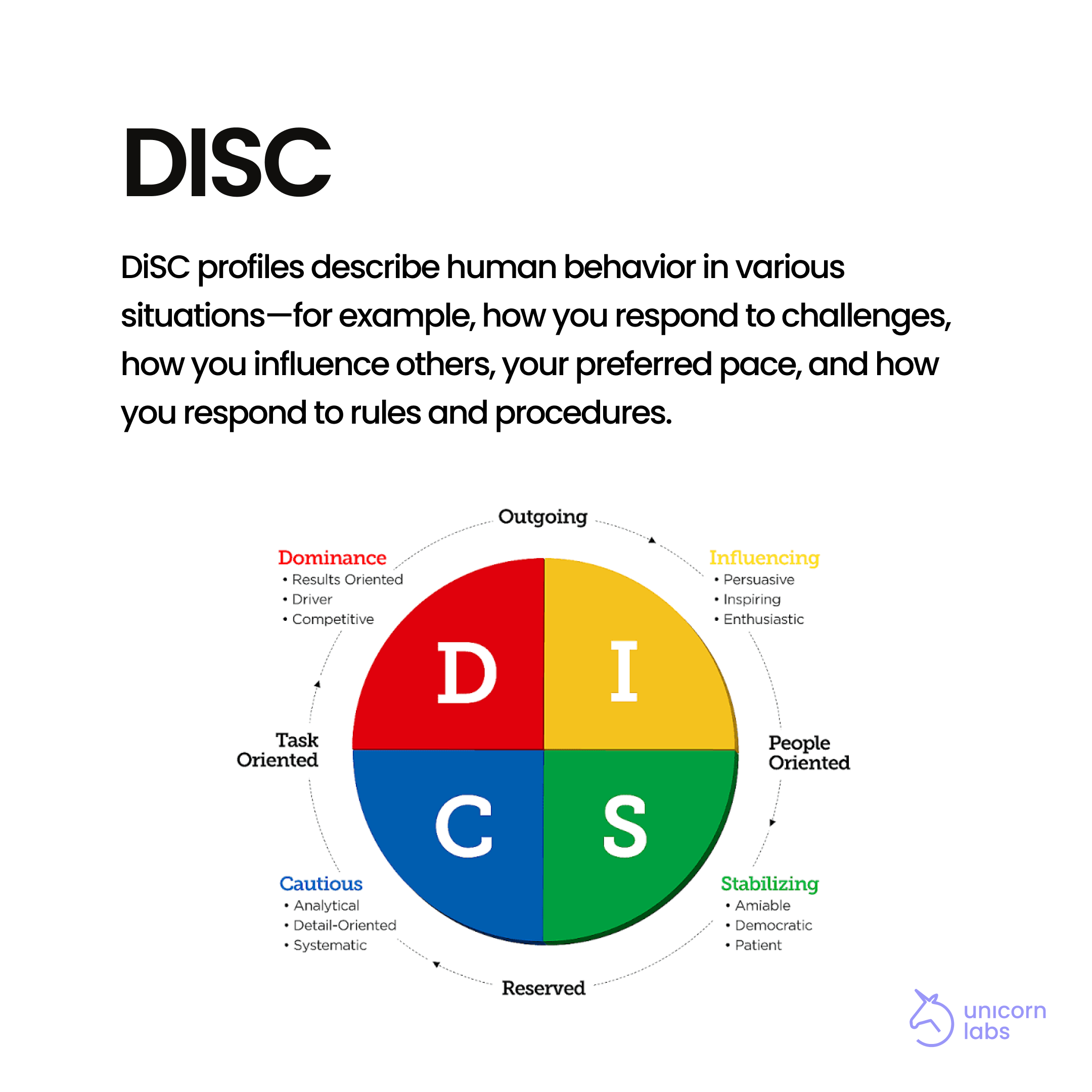
Insights Discovery uses four colour energies (also rooted in Jung) and expands them into a 72-type wheel. Think of it as MBTI's theory with friendlier packaging and more nuance in how types combine.
Notice the split. MBTI and Insights describe who you are inside. DISC describes what you do outside. For a team trying to fix meetings, feedback, and handoffs, that difference is everything.
What the Research Actually Says
This is where the vendor decks go quiet, so let's put the numbers on the table.
MBTI: beloved, but shaky under load. Independent studies have found that 39 to 76 percent of people get a different MBTI type when they retake the test, sometimes after just five weeks. The publisher's own retest data looks better, but the type-flipping problem is well documented in peer-reviewed work.
Validity is the bigger issue. Meta-analytic research puts MBTI's correlation with job performance near zero, roughly 0.0 to 0.10, which is effectively no predictive power at all. It's telling that MBTI is absent from the canonical research hierarchies of what actually predicts job performance, because its validity studies were too thin to include. If your CFO asks "what's the evidence," MBTI gives you the thinnest file of the three.
DISC: narrower claim, sturdier ground. DISC makes a smaller promise, and that's its strength. It doesn't claim to reveal your soul. It claims to describe observable communication behaviour, and research in applied psychology shows behaviour-focused assessments produce team gains only when paired with structured debriefs and follow-up commitments.
That finding matters for any tool you pick. An assessment alone changes nothing. A DISC workshop built around real team scenarios changes behaviour because people practice, commit, and get reinforced.
Insights Discovery: richer map, heavier lift. Insights adds useful nuance. Two "red energy" people can differ a lot, and the 72-type wheel captures that. The trade-off is cost and complexity: accredited practitioners, licensed materials, and a model that takes longer for a team to internalize. Some enterprise teams love it. Most scale-ups don't need it.
The Comparison That Actually Matters for Teams
Here's how the three stack up on the five questions I'd want answered before signing a workshop contract.
A few of those deserve a word more.
On conflict, style clashes drive a large share of workplace friction, and the fix starts with separating the person from the pattern. DISC gives teams a shared, blame-free language for that. Pair it with a clear model for task conflict versus relationship conflict and you can turn most personality clashes into workable disagreements.
On whether managers keep using it, Gallup's research shows managers drive about 70 percent of the variance in team engagement, so a tool only pays off if managers apply it in 1:1s, feedback, and delegation. In our client work, DISC gets reused because flexing your style to the receiver is a concrete, coachable skill. That's the Platinum Rule in action: treat people how they want to be treated, not how you would.
Where All Three Tools Fail
Buy any of these expecting a personality quiz to fix your team, and you'll waste the budget. I've seen it happen with all three logos on the workbook.
Here's the kind of thing that happens. An engineering org runs MBTI one year and a colour-energy workshop the next. Fun days, zero change. Dig in, and the problem is never awareness. People knew their letters and their colours. Nobody had ever practiced a hard conversation using them, and no manager had ever reinforced the language after the session ended.
That's the awareness trap. Assessments without practice are entertainment. At Unicorn Labs we weave DISC through our Six Levels of High-Performing Teams model because a style map only becomes useful once a team has the psychological safety to talk about friction honestly. The tool is a doorway. The work is the room.
So whatever you choose, demand three things from the engagement: real team scenarios instead of generic theory, practice rounds with feedback, and a follow-up mechanism your managers own.
How to Choose: A Quick Decision Guide
The short version for your vendor evaluation doc: match the tool to the job you're actually hiring it for.
If the goal is team behaviour, meetings, feedback, handoffs, conflict, choose DISC. It's built to translate into what people do, and it's the easiest to keep using. If the goal is private, individual reflection, a leader thinking about their own wiring, MBTI can be a useful mirror, as long as it never touches a hiring or promotion decision. If you're an enterprise that wants the deluxe map and has the budget and appetite for accredited delivery, Insights Discovery gives you the most nuance.
And if the honest answer is "our team's problem is trust, not vocabulary," fix that first. No assessment repairs a team that's afraid to speak.
The Tool Is a Doorway
The DISC vs MBTI question has a clean answer for most teams: DISC for team behaviour, MBTI for private reflection, Insights for enterprises that want the deluxe map. The evidence, the price, and the stickiness all point the same way for teams under pressure to communicate better this quarter.
Just remember the assessment is 20 percent of the outcome. The debrief, the practice, and the manager follow-through are the other 80. Spend your budget accordingly: put the money where the behaviour change actually happens.


